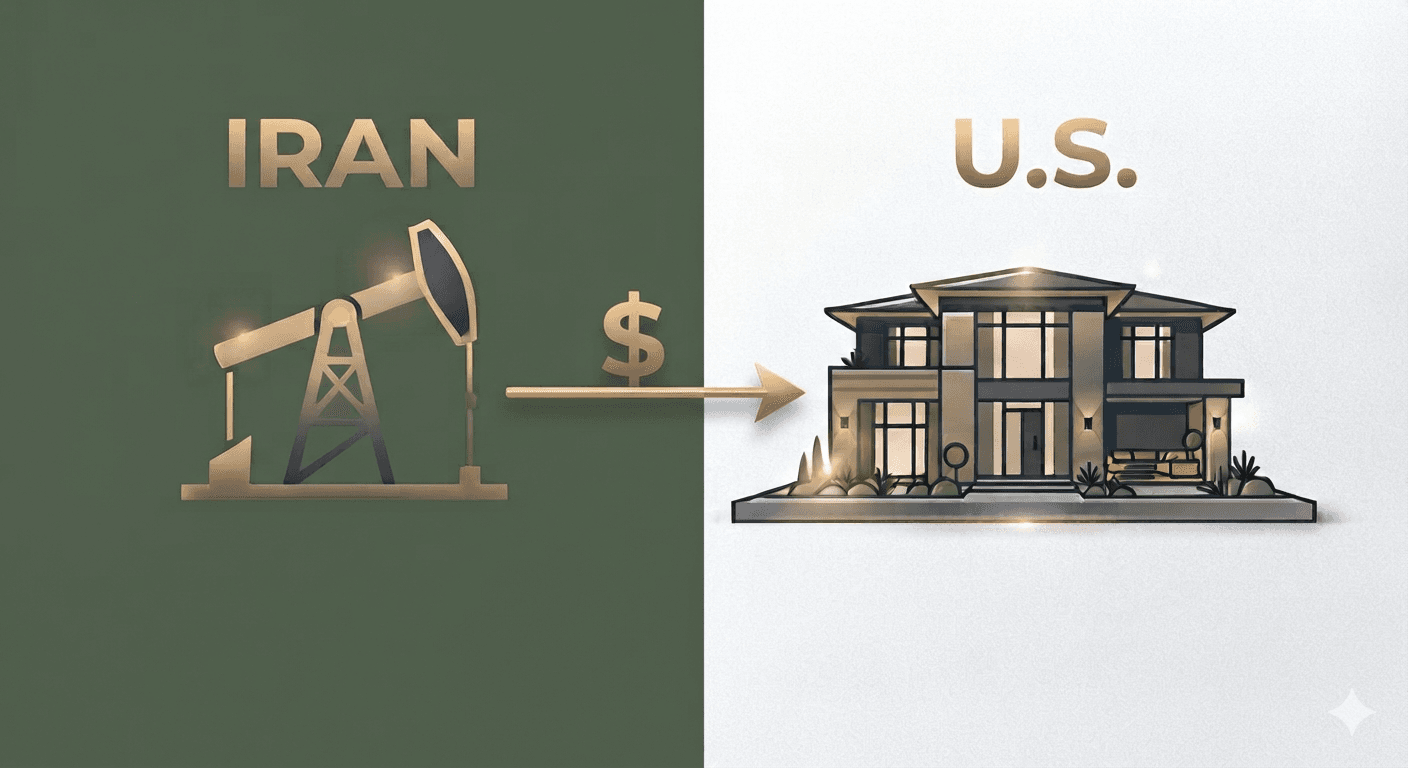
Everything was lining up for the strongest spring housing market in years. Mortgage rates had finally fallen below 6%. Inventory was climbing. Mortgage applications were surging.
Then, almost overnight, the market stalled. Home sales plummeted to a nine-month low, as active buyers suddenly disappeared.
Here's what happened — and why a war half way across the world ended up affecting American homebuyers.
Winter 2026: the anticipation
For homebuyers, the past two years have been rough. High mortgage rates have been squeezing buyers out of the market. However, this spring was set to be the strongest in years. For the first time in four years, the 30-year fixed mortgage rate fell below 6% — the lowest since September 2022.
Amid the anticipation, a geopolitical shock completely changed the outlook overnight. On February 28, the United States and Israel launched a massive joint military operation against Iran, igniting a major regional war.
Immediately, Brent crude oil rose by more than 65%, and inflation spiked from 2.4%, peaking at 4.2% in May. Mortgage rates, which had finally fallen below 6% in February, instead spiked to 6.61% in March — a six-month high.
Spring 2026: the upset
Suddenly, homebuyers froze. Instead of the strongest spring market in years, existing home sales plunged 3.6% in March to their lowest level in nine months, as soaring mortgage rates and geopolitical uncertainty brought buyers to a standstill. It created a double-edged market: inflation continued pushing costs higher while buyer demand simultaneously stalled.
The mechanism: how does a war overseas matter to buyers?
At first glance, a war in the Middle East shouldn't have much to do with homebuyers half way across the world. But it does — and it all revolves around oil.
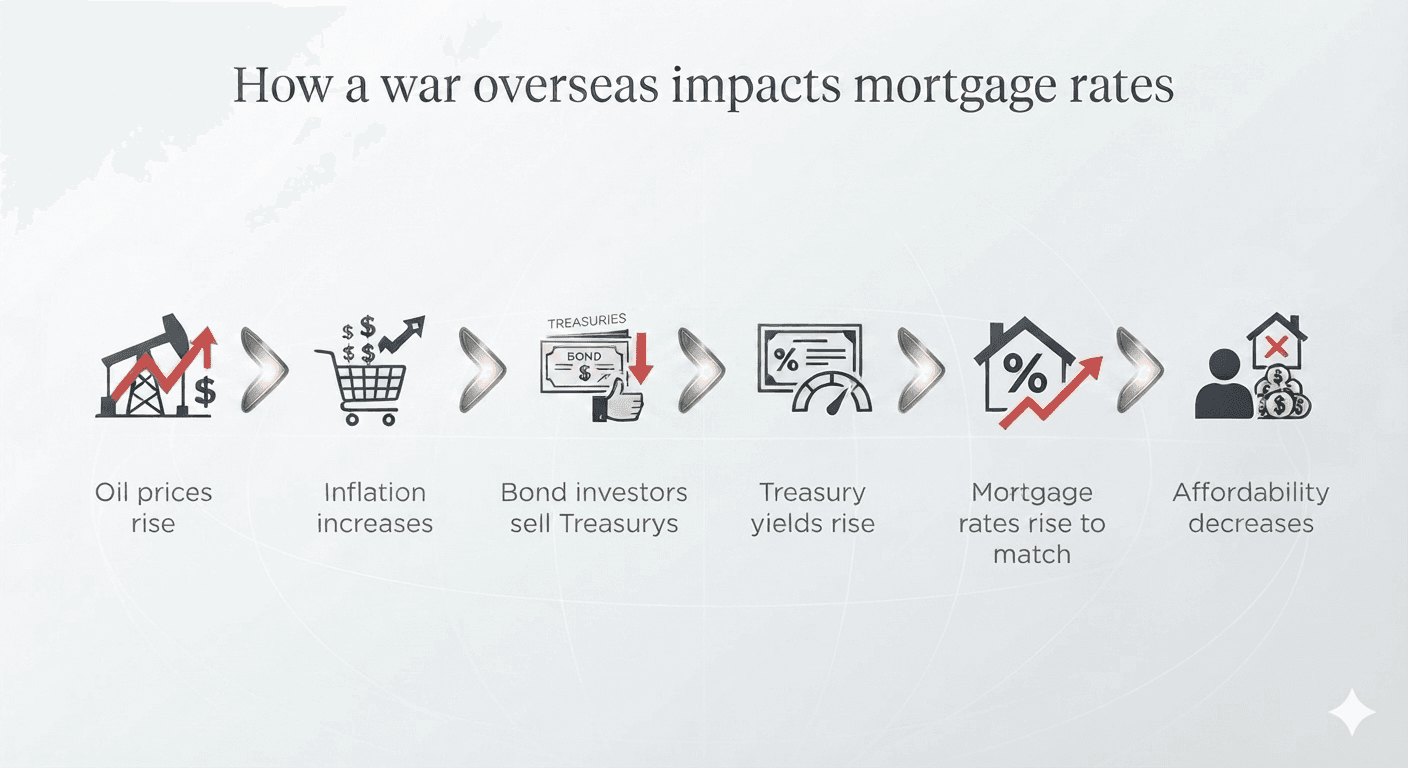
1. Oil prices rise → inflation increases
Everything relies on oil. As oil becomes more expensive, so does everything else, causing inflation.
2. Inflation increases → bond investors start selling → bond value goes down and yield goes up
As inflation rises, investors start selling government-issued bonds, since inflation eats into their returns. As they're sold, their value decreases, increasing their yield.
Between late February and late March, the price of the 10-year US Treasury note decreased from $100.49 to $97.98, forcing its market yield to surge from a low of 3.94% on February 27th up to a monthly average of 4.25%.
Bond price ($)
10-year Treasury yield (%)
View underlying data
| Month | Bond price | Yield |
|---|---|---|
| Jan | $101 | 3.9% |
| Feb | $100.5 | 3.94% |
| Mar | $99 | 4.15% |
| Apr | $97.5 | 4.3% |
| May | $97 | 4.4% |
| Jun | $96.5 | 4.48% |
3. Treasury bond yield increases → mortgage rates increase to match
Treasury yields and mortgage rates tend to move in the same direction. When Treasury yields climb, lenders adjust mortgage rates accordingly to remain competitive. Between February and March, the 10-year Treasury yield rose by 0.31 percentage points, and the average 30-year fixed mortgage rate increased by about 0.40 percentage points. This may not seem like a lot, but it can trigger home prices to drop tenfold.
4. Mortgage rates go up → property affordability decreases
As mortgage rates go up, it becomes more expensive to borrow money and purchase property.
Other contributing pieces
The real estate market is extremely dynamic, and there are many other factors that also influence it.
Cost of construction
Oil prices are also leading to higher construction costs, contributing to property value appreciation. Residential construction input costs spiked at their fastest pace in three years, climbing roughly 4.4% year-over-year.
The rate lock-in effect
Millions of sellers have fixed mortgage rates far below today's rates. Selling their home would mean buying their next home at a 6.4%+ mortgage rate. Because of this, many homeowners are simply refusing to sell — contributing to frozen listings and elevated inventory.
Buyer sentiment
Economic uncertainty and geopolitical tensions can significantly influence buyer confidence. Since purchasing a home is both a financial and emotional decision, uncertainty often plays a major role in determining when buyers choose to act.
The final picture
The housing market isn't in crisis — it's in a period of stagnation.
What's interesting is that from May to mid-July, oil prices have come down roughly $30–$40 a barrel from the spike in April. However, this hasn't impacted the housing market positively. Because core inflation (excluding food and labor) stayed the same, bond investors kept yields at 4.5%, locking mortgage rates in the mid-6% range regardless of cheaper gasoline. As long as core inflation stays high, we can expect rates to remain where they are today.
- Headline inflation
- Core inflation
- 10-year Treasury yield
- 30-year mortgage rate
View underlying data
| Month | Headline inflation | Core inflation | 10-yr Treasury yield | 30-yr mortgage rate |
|---|---|---|---|---|
| May | 4.2% | 5.2% | 4.5% | 6.5% |
| June | 3.8% | 5% | 4.5% | 6.5% |
| July | 3.5% | 4.9% | 4.5% | 6.5% |
History supports this
Historically, most conflicts overseas have not had a significant long-term effect on the US housing market. After the 1979 Iranian Revolution, world oil prices skyrocketed by 165%, US inflation surged past 13%, and mortgage rates almost doubled. Although buyer demand collapsed, nominal home prices did not crash. By 1983, inflation rates fell back below 4% and mortgage rates drifted back to the 12% range, effectively correcting the market.
How do investors take this?
If you already have an investment strategy that has proven to work, stay patient and stick to it. Adapt to the market with thoughtful adjustments, not drastic changes. Here's what I'd recommend:
1. Competitive opportunity for cash buyers
With fewer active buyers and elevated mortgage rates, cash investors can have a stronger negotiating position compared to leveraged investors. They can make more competitive offers and offer faster closing, appealing to sellers who are extra motivated by the stagnant market.
Tip: Find motivated sellers, structure deals optimally, and offer aggressively.
2. Prioritize long-term rentals over flips
Rental income is much less sensitive to mortgage rate influx compared to a property's resale value. Additionally, it can be helpful to avoid capital being frozen in stale listings with the current slow buyers.
3. Expect higher construction costs and budget accordingly
Construction costs have increased 5% and are expected to hit 8% towards the end of the year. Budget an extra 10–15% for renovation and maintenance costs to ensure margin. Investors can also use deal structures like a Guaranteed Maximum Price (GMP) to prevent losses from volatile material and construction costs.
4. Be wary of new construction investments
Construction costs are increasing and demand for new housing is decreasing compared to existing homes. Demand for new construction has decreased 6.8% since May 2025. This creates a high-risk environment for novice new construction investors.
- Existing home sales
- New home sales
View underlying data
| Month | Existing home sales | New home sales |
|---|---|---|
| Jan 2025 | 3.88M | 0.685M |
| Feb 2025 | 3.82M | 0.74M |
| Mar 2025 | 3.96M | 0.685M |
| Apr 2025 | 3.85M | 0.695M |
| May 2025 | 4.01M | 0.715M |
| Jun 2025 | 3.94M | 0.685M |
| Jul 2025 | 3.95M | 0.745M |
| Aug 2025 | 3.9M | 0.705M |
| Sep 2025 | 3.84M | 0.63M |
| Oct 2025 | 3.89M | 0.625M |
| Nov 2025 | 3.82M | 0.63M |
| Dec 2025 | 3.98M | 0.685M |
| Jan 2026 | 4.02M | 0.58M |
| Feb 2026 | 4.13M | 0.625M |
| Mar 2026 | 4.01M | 0.66M |
| Apr 2026 | 4.04M | 0.625M |
| May 2026 | 4.19M | 0.575M |
| Jun 2026 | 4.09M | 0.65M |
Every economic and geopolitical event creates uncertainty, but it also creates opportunity. The investors who succeed are the ones who understand what's driving the market and adapt without abandoning the fundamentals. The headlines will always continue to change, but disciplined and informed investors will always win.